The Platform
The Clauseflint Review Engine
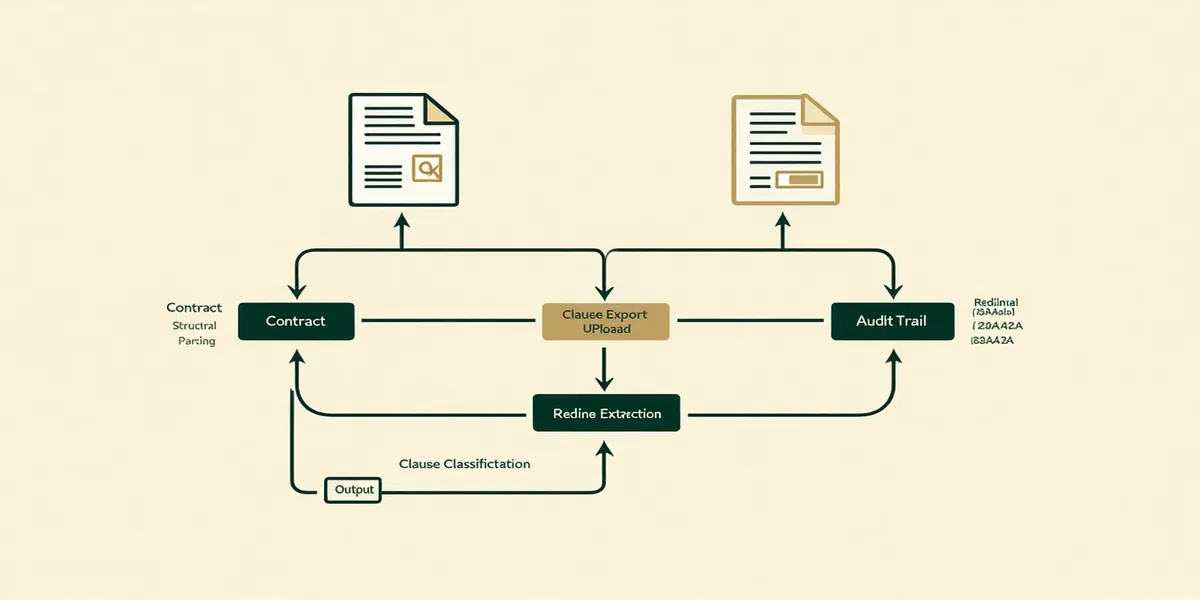
A clause-extraction and risk-flagging pipeline modeled on how experienced deal counsel actually reads a contract: definitions first, cross-references mapped, then clause-by-clause extraction against configurable thresholds. Every flag is traceable to a source page. Every output is auditable.
recall on change-of-control
precision on indemnity caps
Clause Categories
What the engine reads
Change-of-Control
Consent requirements and deal conditions
Every vendor agreement, employment contract, IP license, and software subscription may contain a change-of-control provision. Clauseflint identifies the clause, assesses whether a consent or notice requirement is triggered, and flags the relevant counterparty.
terminate this Agreement upon thirty (30)
days' written notice if the other party
undergoes a Change of Control.
▲ Consent required
MAC Clause
Material adverse change definitions and carve-outs
MAC definitions vary substantially between deals. Clauseflint extracts the operative definition, the carve-out list, and the disproportionate-effect qualifier — presenting each for counsel review alongside a risk assessment.
event or effect that is, or would reasonably
be expected to be, materially adverse to
the business, financial condition or results
of operations of the Company...
▲ Carve-out review required
Indemnity
Cap multiples, mutual vs. asymmetric, carve-outs
Indemnity cap structure — the multiple, the carve-out list (IP infringement, fraud, data breach), and whether the cap is mutual — is flagged against configurable thresholds per counterparty size and contract type.
this Agreement shall not exceed five (5)
times the Fees paid in the twelve (12)
months preceding the claim.
⚠ Cap at 5× fee
Assignment & Non-Compete
Transfer restrictions and post-termination obligations
Assignment restrictions affect deal structure. Post-termination non-compete and non-solicit clauses affect integration planning. Both are extracted with operative period, geographic scope, and counterparty identification.
without the prior written consent of the
other party, except to an affiliate or in
connection with a merger or acquisition.
⚠ Assignment restricted
Accuracy
Internal benchmarks on commercial contract corpus
Measured on a held-out corpus of 4,000+ clauses drawn from M&A and commercial contract categories. These are internal benchmarks — not independently audited. We are happy to share the evaluation methodology on request.
| Clause Type | Recall | Precision | Notes |
|---|---|---|---|
| Change-of-Control | 94% | 92% | Including multi-party and cross-reference structures |
| MAC / Material Adverse Effect | 91% | 89% | Carve-out lists extracted separately |
| Indemnity Cap | 93% | 91% | Cap multiple and carve-outs identified |
| Assignment Restriction | 90% | 88% | Affiliate carve-outs flagged separately |
| Auto-Renew / Notice Window | 96% | 94% | Notice period extracted as structured field |
| Non-Compete / Non-Solicit | 87% | 85% | Geographic scope and duration extracted |
Auditability
Every flag is traceable
Every clause flag links back to a specific contract, page number, and line range. When a counterparty disputes a position — or when regulators request documentation of the diligence process — the audit trail is already built.
The audit log exports as a structured CSV or PDF, organized by clause category, with timestamps and reviewer attribution where applicable.
# Audit log excerpt
contract_id: "VDR-00142"
clause_type: "change_of_control"
page: 12
lines: [34, 51]
risk_level: "high"
flag_reason: "Consent required on CoC"
flagged_at: "2026-03-14T09:22:01Z"