When an in-house legal team has 800 vendor contracts and a team of two, full review of every agreement is not feasible — and attempting it produces worse outcomes than a well-designed triage system. The question is not whether to triage, but whether the triage criteria are principled enough to ensure that the contracts most likely to generate material risk actually receive the attention they need.
This article describes a vendor contract triage framework built for legal operations teams: a tiering structure based on contract value and risk profile, thresholds for determining review depth, security addendum requirements, and the ongoing monitoring workflow that third-party risk management requires after initial triage.
The Problem with Volume-Based Approaches
The intuitive approach to vendor contract triage is to prioritize by contract value: review everything above $X, spot-check contracts between $X/2 and $X, and file everything below $X/2. This approach has surface logic — higher-spend relationships are generally more material to business operations — but it fails to account for the fact that contract risk and contract value are not the same variable.
A $15,000-per-year software agreement that handles personal data for 50,000 customers carries more legal risk than a $200,000 facilities maintenance agreement that doesn't. A cloud infrastructure contract at $80,000 per year with an uncapped liability provision and no SLA creates different exposure than a professional services agreement at $150,000 with a well-negotiated indemnity cap and detailed service level commitments. A purely value-based triage framework will systematically under-review high-risk, low-value contracts while over-reviewing low-risk, high-value ones.
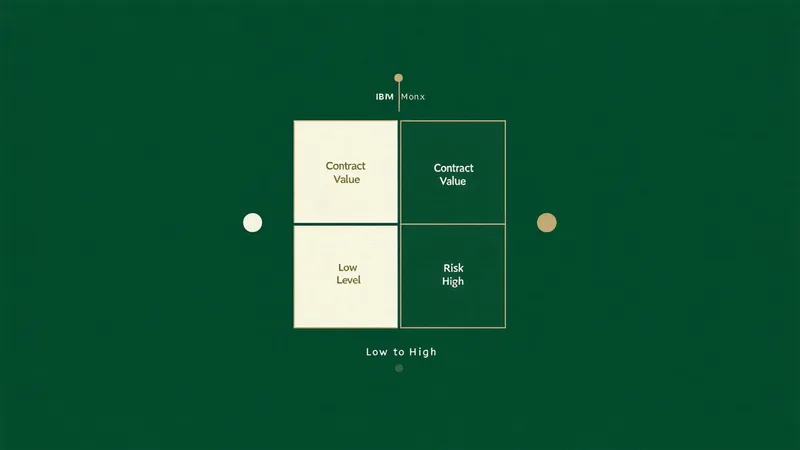
The framework described here uses a two-axis triage matrix: contract value on one axis, risk profile on the other. The combination of the two axes produces a four-quadrant assignment that determines review depth, not contract value alone.
The Two-Axis Triage Matrix
The value axis uses a threshold that should be calibrated to the organization's size and risk tolerance. For a mid-market company ($50M-$500M revenue), a workable set of thresholds is: High value = annual contract value above $100,000; Medium value = $25,000-$100,000; Low value = below $25,000. These thresholds compress toward the low end for smaller organizations and expand upward for large enterprises. The point is not the specific numbers but having defined thresholds that the team applies consistently.
The risk axis requires a brief assessment of four factors: data handling scope (does the vendor receive, process, or store personal data or sensitive business data?); access scope (does the vendor have access to production systems, networks, or critical business infrastructure?); business criticality (would a vendor failure or termination cause material business disruption within 30 days?); liability terms (does the agreement contain unusual liability exposure — uncapped indemnities, broad IP assignment language, or unusual intellectual property clauses?).
Each factor is a binary yes/no assessment. A vendor with two or more "yes" answers is High Risk. One "yes" is Medium Risk. Zero "yes" answers is Low Risk. The matrix then assigns review depth by quadrant:
- High Value / High Risk: Full review by attorney. Key clause categories reviewed: indemnity structure, data handling and security addendum, SLA and service continuity, change-of-control, assignment restrictions, liability caps and consequential damage exclusions, IP ownership, audit rights. Redline against company playbook required.
- High Value / Low Risk: Focused review on commercial terms — pricing, term, renewal, payment, and termination for convenience. Clause-level review of liability structure only. Security addendum review if any data access, however limited.
- Low Value / High Risk: Focused clause-level review on data handling, liability, and security addendum requirements. No full commercial terms review. Flag for security team if any system access involved.
- Low Value / Low Risk: Standard-form review only. If counterparty has presented their own non-standard form, flag for attorney review. If using company's standard vendor form, execute on approval authority without full legal review.
Security Addendum Standards
The security addendum — also called a Data Processing Agreement (DPA), Data Security Agreement, or Information Security Addendum depending on jurisdiction and context — is a recurring battleground in vendor contracting for organizations subject to privacy regulations or contractual data handling obligations to their own customers.
A baseline security addendum for a growing technology or services company should address: permissible uses of data (data may only be processed per the company's documented instructions); security standards (typically specified as ISO 27001-equivalent controls or SOC 2-type operational standards, without requiring the vendor to hold a specific certification); subprocessor restrictions (vendor may not subcontract data processing without prior written notice); breach notification (vendor must notify within 72 hours of becoming aware of a breach affecting company data); audit rights (company has the right to audit vendor's security practices on reasonable notice, or receive a third-party audit report); and data return or deletion on termination.
We're not saying that every vendor needs an addendum of equal complexity. We're saying that any vendor in the High Risk category — particularly those with data handling scope — should have security addendum terms that meet at least the baseline standard above, and that the in-house team should have a standard addendum template to propose when the counterparty's terms are missing or inadequate.
In practice, many mid-market in-house teams don't have a finalized security addendum template and negotiate addendum terms reactively each time the issue arises. The result is inconsistent protection across the vendor portfolio — some vendors have well-constructed addendum terms because a specific negotiation went well; others have no addendum at all because the issue wasn't raised at the time of signing. A triage framework that identifies High Risk vendors consistently also identifies where security addendum review is required, which is the prerequisite for systematic addendum coverage.
Approval Authority and Threshold Design
A common failure mode in vendor contracting is that triage criteria are defined but approval authority thresholds aren't aligned with them. Legal has designed a careful triage matrix; the business signs contracts that don't get routed through it because the contract value falls below the procurement team's approval threshold and nobody remembered to route it to legal.
The triage matrix only works if it's the routing mechanism that actually governs inbound contracts. That requires alignment between legal's triage criteria and the procurement team's approval workflow. In practice, this usually means defining a legal review trigger that is separate from the procurement approval trigger: legal review is required for any contract that meets any one of the risk axis criteria, regardless of contract value. The procurement approval process handles commercial terms; legal review handles risk terms.
At a growing B2B software company — approximately 120 employees, primary revenue from enterprise contracts — the in-house counsel implemented a triage system where any new vendor contract with data access scope was routed to legal automatically through the procurement intake form, regardless of contract value. The business initially pushed back on the routing overhead for small contracts. Within the first quarter, the system identified two contracts below $20,000 annually that contained liability terms the business had not noticed: one had a broad IP assignment clause that would have transferred ownership of custom integrations built by the vendor to the vendor on termination; one had an uncapped indemnification provision for data handling failures. Neither issue would have surfaced under a value-only triage approach.
Ongoing Third-Party Risk Monitoring
Initial contract triage addresses risk at the time of contracting. Ongoing vendor risk monitoring addresses the reality that vendor relationships evolve — vendors change ownership, change their security practices, change their subprocessors, or encounter operational difficulties — and that the risk profile of a vendor signed two years ago may be materially different from its risk profile today.
A practical ongoing monitoring program for a legal operations team with limited bandwidth focuses on three triggers: auto-renewal windows (at 60-90 days before auto-renewal, initiate a brief re-assessment of the vendor's risk tier and determine whether terms should be renegotiated before renewal); material vendor changes (vendor change-of-control, significant service outage, or public security incident triggers a review of the agreement's provisions relevant to that event); and regulatory changes (changes in applicable privacy law, data residency requirements, or sector-specific regulation that affect the adequacy of current contract terms).
The auto-renewal monitoring piece requires a contract renewal calendar — a tracked record of renewal dates and notice windows across the vendor portfolio. This is often maintained in a spreadsheet or a CLM tool, with calendar alerts set at the 90-day window. The discipline is not in the tooling; it's in consistently capturing renewal dates at the time of signing and maintaining the calendar as contracts are added, modified, and terminated.
Integrating Triage with Contract Review Tooling
The triage framework described above is most useful when it's operationalized — built into the workflow that governs how contracts are received, classified, reviewed, and signed, rather than existing as a document that counsel consults occasionally. That operationalization requires some combination of intake form, routing logic, review checklist by tier, and output tracking.
Clauseflint's vendor risk module supports the High Risk review track specifically: it surfaces clause-level flags for indemnity structure, data handling scope, security addendum adequacy, liability caps, and auto-renewal terms, organized by the risk categories that matter for vendor risk assessment. The triage classification — which tier a given contract falls into — is still a human judgment call based on the risk axis criteria above. What the tool changes is the review depth and quality once a contract has been classified as requiring legal attention: the attorney's review is focused on the flagged provisions rather than starting from a blank page on a contract they may not have reviewed before.
The triage framework and the review tool are complementary, not substitutes. A rigorous triage system without adequate review of the High Risk contracts produces a well-organized backlog of unreviewed risk. A review tool without a triage framework produces thorough reviews of contracts that didn't need thorough review while the material risks sit in a queue. Both pieces are required for vendor contract risk management that actually reduces exposure rather than just documenting it.